Technology

Actively Seeks & Destroys Contaminants

How It Works

The Science of Hydroxyls

Nature's own air-cleaning process, recreated in your home — hydroxyl molecules seek out and break down pollutants at the molecular level.
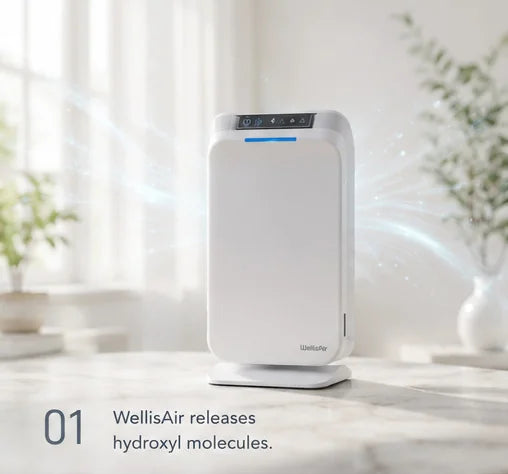
WellisAir purifier in a bright room releasing hydroxyl molecules — Step 1
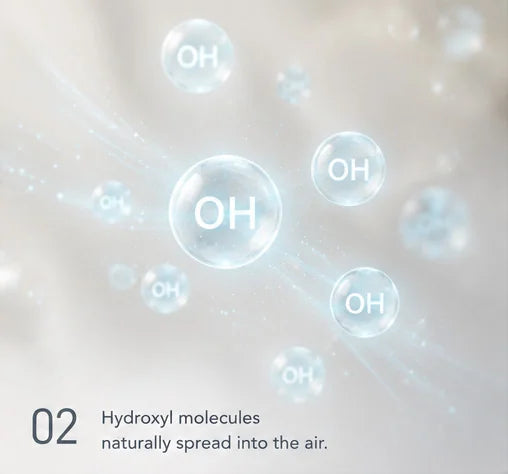
Hydroxyl (OH) molecules spreading naturally into the air — Step 2
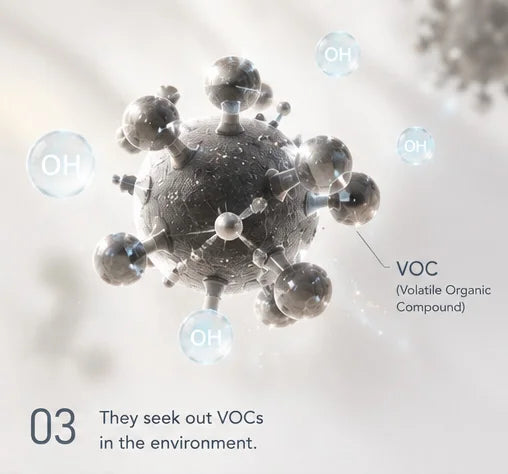
Hydroxyl molecules seeking out a VOC (Volatile Organic Compound) — Step 3
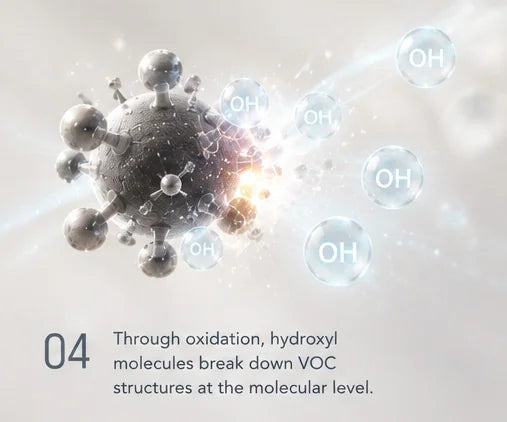
Hydroxyl molecules breaking down a VOC through oxidation — Step 4
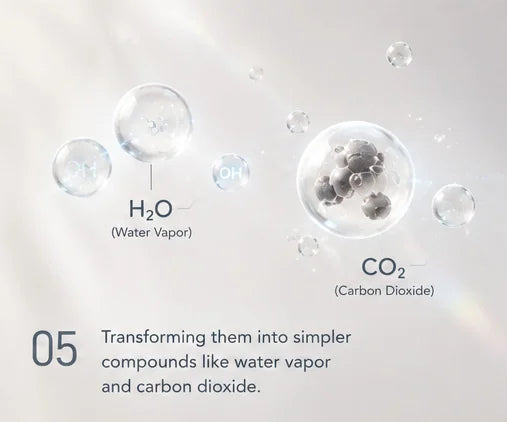
VOCs transformed into water vapor (H2O) and carbon dioxide (CO2) — Step 5
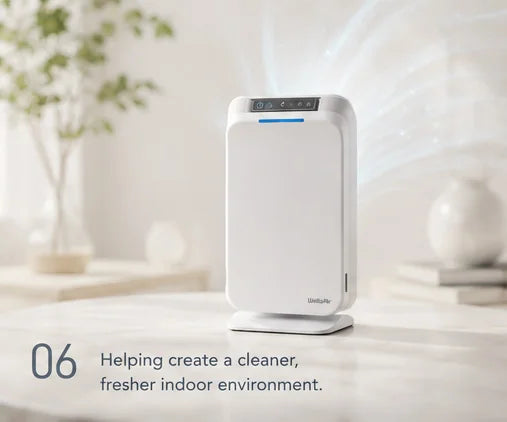
WellisAir purifier in a clean, fresh indoor environment — Step 6
WellisAir Powered by nature. Perfected by science.
  • Gases

  • VOCs

  • Smoke

  • Odors

WellisAir Patented Technology Explained

How Hydroxyl Neutral Molecules Target Contaminants

What the patent covers

The core technology is covered by US Patent No. 11,191,862, granted to Wellis Co., Ltd. in December 2021 and in force until 2035, with additional patents in South Korea, China and the European Union.

What the patent actually describes, and why it separates this from the devices buyers are warned about. The claim is specific: ozone is generated inside the unit to produce hydroxyl radicals — and the hydroxyls are what leaves the device.

That is a meaningful distinction. An ozone generator’s output is ozone: it fills the room with the oxidant and leaves it there to do the work. An ionizer charges particles so they clump and settle, which relocates them rather than breaking them down. Here the ozone is a reagent consumed in making something else, which is why Intertek measured only 0.002 to 0.006 ppm leaving the unit, against California’s 0.050 ppm limit for an air cleaner in an occupied space.

What the patent establishes is that this mechanism was examined against the prior art — ozone-releasing devices among it — and granted as a distinct invention. Read the patent.

WellisAir Releases Hydroxyl Neutral Molecules 24/7

WellisAir uses nature's "detergent of the atmosphere" to seek out both surface and airborne particles. Unlike filters, which can only clean the air that passes through the unit, WellisAir's unique proactive technology relentlessly targets contaminants wherever they are — in the air, on surfaces, even inside the walls and vents.

Hydroxyl Neutral Molecules Steal Hydrogen

WellisAir's Hydropure Molecules steal hydrogen from microscopic contaminants. Removing a hydrogen molecule neutralizes the offending pollutant. The stolen hydrogen (H) is then joined with oxygen (O2) to form H20, which evaporates as completely harmless and clean water vapor without increasing the humidity.

Continuous Monitoring

WellisAir's smart monitoring technology continuously tests the air, alerting you to the presence of VOCs — and assuring you with a blue light once they've been neutralized.

Why half a second is long enough

A fair objection to all of this: a hydroxyl radical survives about half a second. How can anything that short-lived clean a whole room?

Because a hydroxyl does not disappear when it reacts — it converts. It takes a hydrogen atom from a pollutant molecule and becomes HO₂. HO₂ meets nitric oxide and converts straight back to OH. The radical is consumed and regenerated in a loop, and the loop is what does the work.

Measured in the atmosphere, that loop runs on a clock. A HOx radical is recycled every 28 seconds, and the reactive pool lasts about 108 seconds — roughly four cycles before the chain ends. The pool outlives any single radical by more than two hundred times.

Where this stops. These are figures for the outdoor atmosphere, not measurements taken inside a room, and not measurements of a WellisAir unit. The typical chain runs about four cycles — a real multiplier, not an endless cascade.

Source: Monks, P.S., “Gas-phase radical chemistry in the troposphere,” Chemical Society Reviews, 2005, 34, 376–395, p.380.

Say Goodbye to Dirty Filters

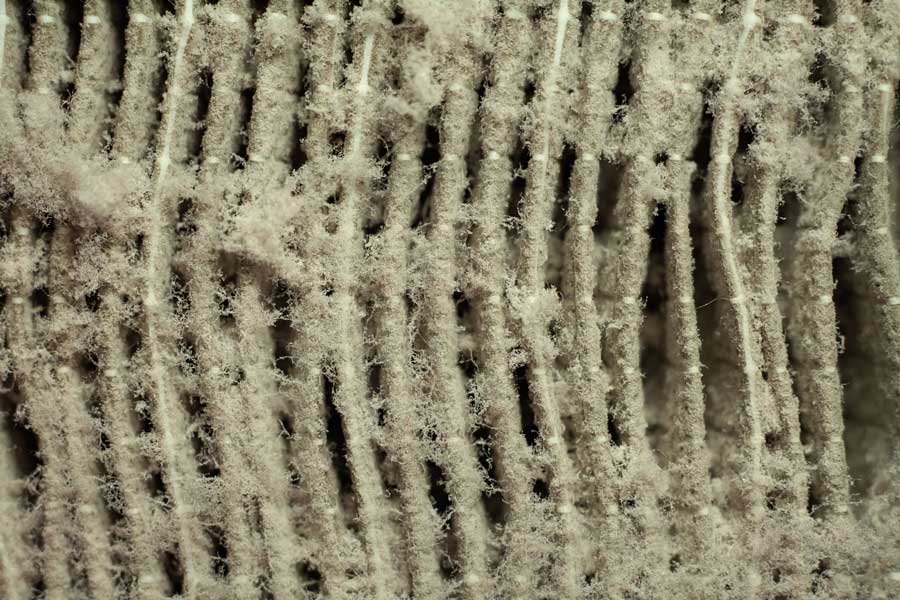
Most air purifiers — even high-end expensive ones — rely on passive mechanisms which simply draw in air from the room and run it through a filter. This means that the only contaminants which are trapped are those which are airborne, and which are close enough to the unit to get sucked in.

WellisAir is proactive and dynamic — capturing contaminants mid-air, and seeking them out on surfaces.

  • Conventional HEPA systems capture particles through its filter, but fails to kill them. This inefficient and passive process results in the presence of dead zones in a room where the air is not circulated.
  • Conventional HEPA systems demand frequent filter changes, every 3-6 months, which is a dangerous chore, exposing people to the contaminants they hoped to trap. Often changing a HEPA filter will reintroduce contaminants onto your fingers, eyes, and the air. With WellisAir, you simply have to pop in a clean new cartridge — easier than swapping in new ink in a printer.
  • HEPA systems also consume high amounts of energy — and must be loud to be at all effective. WellisAir only requires 25 cents worth of electricity per month to operate, and is 80% quieter than the quietest filter on the market.

Independent 3rd Party Lab Results