

Letter from CEO: What a Mayo Clinic study revealed about your neighborhood
A study came across my desk last week that I haven’t been able to stop thinking about. The Journal of the American Medical Association published research from the Mayo Clinic that tracked people in southeastern Minnesota for 25 years. The headline: people living within one mile of a golf course had a 126 percent higher risk of developing Parkinson’s disease than people who lived more than six miles away.¹
I read that number three times before it settled in.
Then I thought of you.
You’ve heard me say it before. I built this company because my daughter got sick from something none of us could see. That principle, that the invisible threats are usually the dangerous ones, is the lens I read every new study through. The golf course research hit me in that exact place.
Some of you live in golf course communities. Florida, Arizona, the Carolinas, Palm Springs, Phoenix, Las Vegas. You moved there for the views, for the fairways out the back window, for the quiet of a manicured neighborhood. The new research isn’t telling you to move. It’s telling you to understand what’s happening in the air and water around you, and what you can do about it.
Here’s how the exposure happens. Pesticides used on golf courses move two ways. They leach into groundwater, which is why filtering your drinking water is the first thing experts recommend. They also drift through the air during and after spraying, landing on patio furniture, settling on windowsills, getting tracked into the house on shoes and on pet paws.
The chemicals at stake here aren’t minor. Glyphosate, the most common herbicide on American fairways, is classified by the World Health Organization’s International Agency for Research on Cancer (IARC) as probably carcinogenic to humans.² Chlorothalonil, a fungicide used on greens, is banned across the European Union. In the United States, golf courses apply up to 15 times more pesticide per acre than European courses do.
Now the part you need to hear.
Most of the advice circulating online tells homeowners to use a HEPA filter, close their windows during spraying, and clean their surfaces. That advice is incomplete. HEPA filters trap particles. They don’t destroy chemical vapors. Pesticides drift as both particles and vapors, and the vapor portion, the VOCs, those go right through HEPA like it isn’t there.
Your WellisAir works on a different principle entirely. The hydroxyls it generates do the same thing nature does outdoors when sunlight hits humidity in the atmosphere. They break VOCs down at the molecular level. Our independent lab in Barcelona, CRESCA-UPC, certified that destruction at 94.3 percent in 30 minutes, with formaldehyde broken down at 93.4 percent.³ That isn’t filtration. That’s chemistry.
Here’s the truth I want you to sit with.
While the rest of the world is just now hearing about pesticide drift and scrambling to buy a HEPA filter, you’ve been quietly ahead of this. The unit on your shelf has been doing the job the new research is telling everyone they need.
You saw it before they did.
You always do.
Two requests before I sign off.
First, if you have a parent, a child, a sibling, a friend who lives near a golf course, please forward this letter to them. The research is real. The exposure is real. Most people have never been told. Second, if you’ve been thinking about adding a second WellisAir to your home, a unit for the bedroom, a unit for a parent’s house, that decision may matter more today than when you first considered it. You’re the reason this company exists. You bought in when most people had never heard the word hydroxyls. You trusted me with the air your family breathes. I will never stop earning that.

WellisAir is not a medical device and is not intended to diagnose, treat, cure, or prevent any disease. Personal experiences referenced in this letter are individual and not representative of expected outcomes. Statements regarding pesticide exposure and disease risk are based on published peer-reviewed research and are not medical advice. For guidance specific to your health, please consult a qualified healthcare professional.
SOURCES
¹ Krzyzanowski B, Mullan AF, Dorsey ER, et al. "Proximity to Golf Courses and Risk of Parkinson Disease." JAMA Network Open, May 2025. doi:10.1001/jamanetworkopen.2025.9198
² International Agency for Research on Cancer (IARC), World Health Organization. Monograph 112: Glyphosate Evaluation, 2015. Classification: Group 2A, probably carcinogenic to humans.
³ CRESCA-UPC, Universitat Politècnica de Catalunya, Barcelona. VOC and formaldehyde destruction efficacy testing. Report 20190930.
Common Golf Course Pesticides and Their Health Effects
The chemicals listed below are among the most commonly applied to American golf courses for turf maintenance. Health effects and cancer classifications are drawn from public records of the U.S. Environmental Protection Agency (EPA), the International Agency for Research on Cancer (IARC) of the World Health Organization, university extension programs, and peer-reviewed research summaries. Where the EPA and IARC reach different conclusions on cancer classification, both positions are listed in the interest of transparency.
ABOUT THE CLASSIFYING AGENCIES
IARC stands for the International Agency for Research on Cancer. It’s the cancer research arm of the World Health Organization, headquartered in Lyon, France. IARC evaluates chemicals, exposures, and lifestyle factors based on published peer-reviewed research and assigns each one to a classification group:
Group 1: Carcinogenic to humans
Group 2A: Probably carcinogenic to humans
Group 2B: Possibly carcinogenic to humans
Group 3: Not classifiable as to its carcinogenicity to humans
IARC classifications carry significant scientific weight because the agency is independent of industry and bases its determinations on global peer-reviewed evidence.
EPA stands for the U.S. Environmental Protection Agency. The EPA evaluates pesticide cancer potential through its Office of Pesticide Programs and uses a parallel descriptor system: Carcinogenic to Humans, Likely to Be Carcinogenic to Humans, Suggestive Evidence, Inadequate Information, and Not Likely to Be Carcinogenic to Humans. IARC and EPA sometimes reach different conclusions on the same chemical because they apply different evidentiary standards and weigh the available data differently.
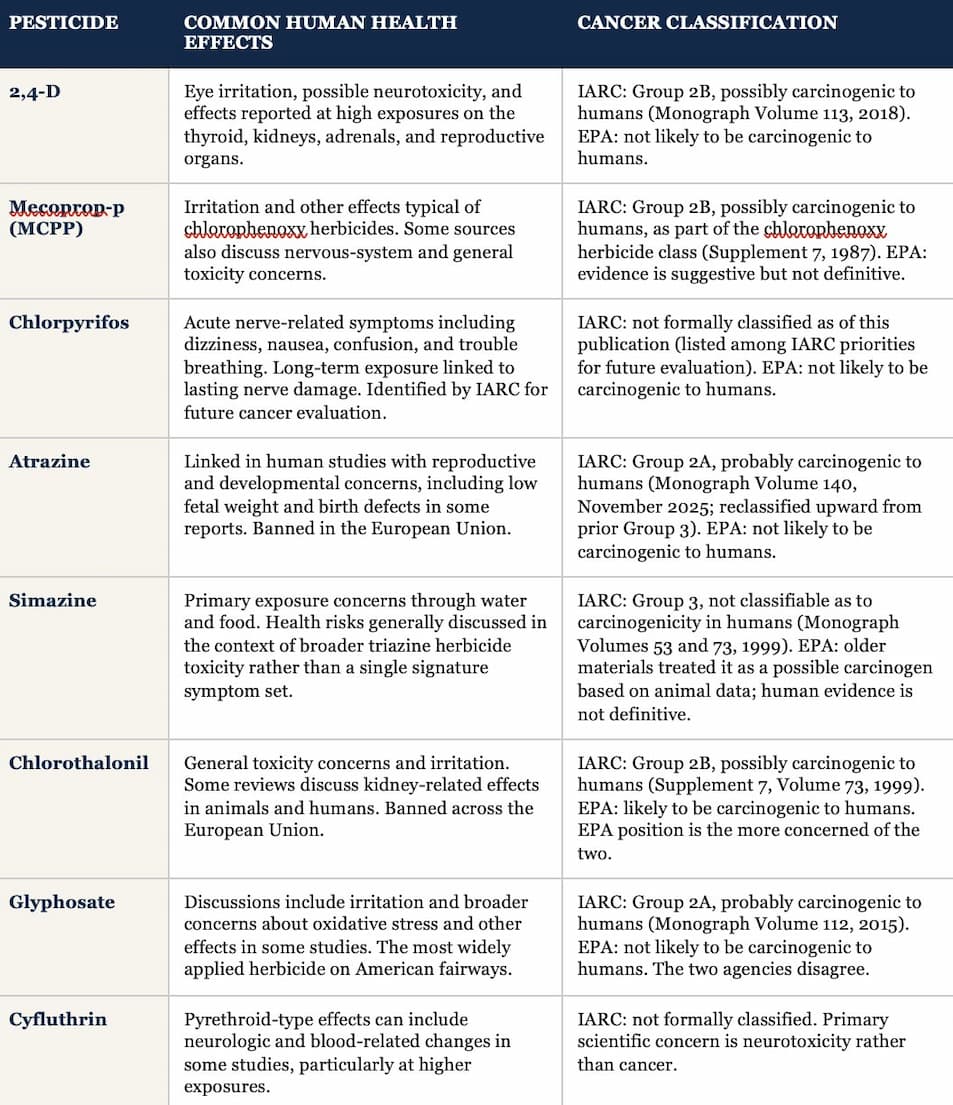
Summaries above synthesize publicly available information from EPA pesticide fact sheets, IARC monographs (World Health Organization), the National Pesticide Information Center (NPIC) at Oregon State University, the CDC, Cornell Cooperative Extension, the National Institutes of Health (PubMed Central), and peer-reviewed scientific literature. Classifications and findings evolve as new research is published; the information above reflects publicly reported positions as of this letter. This appendix is informational and is not medical advice.