

A Note from the CEO: HEPA catches. We convert. The Hydroxyl Difference.
I read the customer emails myself, all of them, and lately the same note keeps arriving. “The dog smell is gone and nobody used a candle.” “We finally opened the guest room and it didn't smell like a guest room.” “I walked in after two weeks away and the house was fresh.”
Nobody writes that about a HEPA filter. Let me explain what you're feeling.
HEPA is good technology and I won't pretend otherwise. A good filter pulls particles out of the air. Dust, dander, pollen. It does that job well. We don't compete for that job, we've never claimed to capture particles, and we're not going to start.
Here's what nobody tells you. Most of what makes indoor air feel heavy isn't the particles. It's the gas. Formaldehyde off-gassing from cabinetry, flooring, and furniture. Benzene from fresh paint or your attached garage. The chemical haze off a new couch that lingers for months. Cooking odors. Cleaning products. A HEPA filter can only act on what physically passes through it, but gas-phase compounds go through like water through a tennis racket. Even activated carbon grabs some of them for a while, but carbon saturates within weeks under real household conditions. Sadly, carbon filters can release what they capture back into the room, and most people never change them in time.1
That blind spot is the entire reason WellisAir exists.
Here's what's happening inside your unit, in plain English.
Every day, sunlight hits water vapor and splits H2O into two pieces. One of them is OH, a hydroxyl. The other is H, a single hydrogen atom.
A hydroxyl wants exactly one thing. It wants to be water again. To get there it needs a hydrogen atom, so it takes one from the nearest molecule it can find, turns back into H2O, and the cycle closes. No waste, no leftover energy, nothing left behind.
Here's why that matters. When the nearest molecule happens to be a virus, a bacterium, a VOC, an odor compound, a mold spore, or a mold mycotoxin, losing that hydrogen atom is the end of it. The toxin is neutralized. The hydroxyl becomes water. That's how nature keeps itself in balance. Mother Nature's infinite wisdom.
Sunlight is nature's power source. Your cartridge is ours. It holds the fuel, the generator converts it into hydroxyls, and those hydroxyls spread out through the whole room, into corners and across surfaces no filter can ever pull air toward. They're produced continuously, day and night, so the conversion never stops. Your unit isn't filtering your air. It's converting it into the same forest fresh air nature makes outside.
This hydroxyl generator is what we hold the patent on. U.S. Patent No. 11,191,862 B2, granted December 7, 2021 and extended to Europe, Korea, and China.
We don't capture. We convert. That isn't a tagline. It's a description of the physics.
Here's what happened when independent labs put it to the test.
A Barcelona lab sealed a unit inside a test chamber and watched what happened to the air. Within 30 minutes, about 94 percent of the VOCs were gone compared to an identical chamber with nothing running in it. Formaldehyde, the compound IARC classifies as a known human carcinogen, dropped about 93 percent in that same half hour.2
MRSA, the staph infection hospitals fight hardest, came down 99.9 percent.3
RSV, the virus that fills pediatric wards every winter, came down 99 percent on wet surfaces and 92 percent on dry ones.4
On safety, the WADU-02 is CARB certified. California wrote the country's first ozone safety standard for indoor air devices, and we meet it.5
You also own a live demonstration of all of this. The indicator turns red when it's detecting contaminants and blue when the air has cleared. Open a door on a warm afternoon and watch it go red as exhaust and heat-driven off-gassing roll in. Check it an hour later. That color change is your unit showing you its work.
Which brings me to today.
We didn't plan a four-unit bundle. You did. The most common message in our inbox this year hasn't been a question about the technology at all. It's been some version of “how do I cover the rest of the house?” Bedroom, kitchen, office, a unit for a parent or a kid heading to a dorm. People who started with one room got tired of walking into a room that felt different from the one they left.
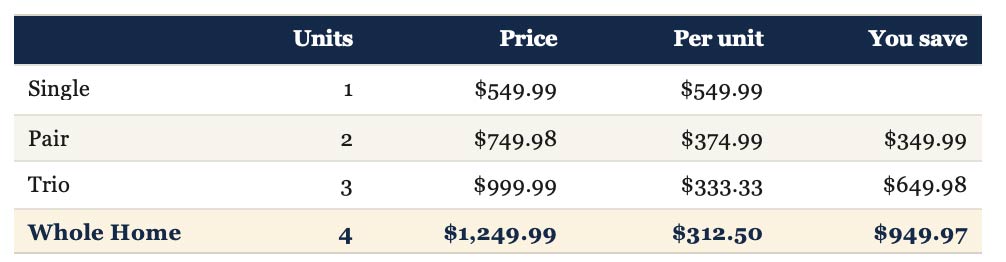
Starting today, four units are $1,249.99. That's $312.50 each, and $949.97 less than buying four singles.

CEO, WellisAir
ENDNOTES
1. U.S. Environmental Protection Agency, American Lung Association, and Lawrence Berkeley National Laboratory guidance on activated carbon saturation and re-release in residential air cleaning.
2. Universitat Politècnica de Catalunya, CRESCA institute, sealed chamber study, report 20190930. VOC reduction approximately 94 percent and formaldehyde reduction approximately 93 percent measured against an untreated control chamber at 30 minutes. Formaldehyde classified as Group 1, carcinogenic to humans, by the International Agency for Research on Cancer.
3. Korea Conformity Laboratories, reports 027129 and 027131, efficiency against Methicillin Resistant Staphylococcus aureus, 99.9 percent reduction.
4. University of Barcelona, reports 20191212-3 and 20191212-4, Respiratory Syncytial Virus, 99 percent reduction wet and 92 percent reduction dry.
5. California Air Resources Board Executive Order G-20-280, issued November 12, 2020 for the WADU-02, tested to ANSI/UL 867, ozone emission concentration below the 0.050 ppm state limit. California adopted the nation’s first ozone emission standard for indoor air cleaning devices under Assembly Bill 2276 (2006).